Social Media & Optimisation
Assignment 1 – Portfolio & Reflection
by Thomas Green, April 2025
The client
Brandwin Digital
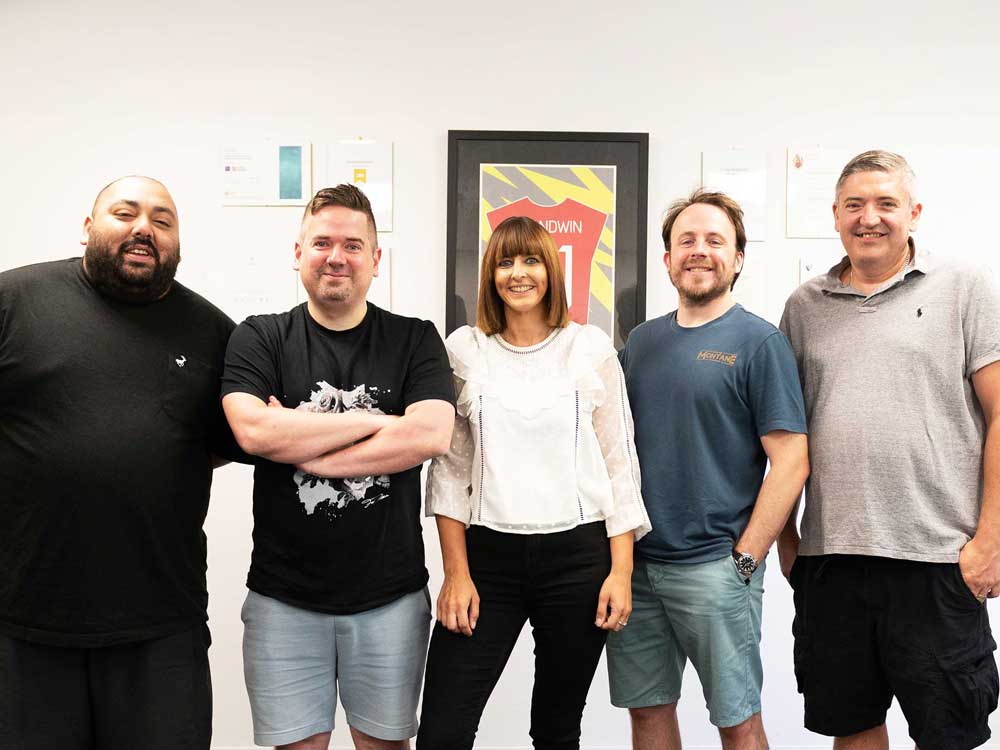
Brandwin Digital are a small digital marketing agency based in Manchester who provide a range of digital marketing services, including website design, hosting, SEO, PPC Campaign Management and social media posting, to primarily other small to medium sized businesses. Although not by design, most of Brandwin Digital’s customers are locally operating service providers based in the UK.
Brandwin Digital have been in business since August 2021 and are now in a position where they feel established in their marketplace and want to offer an increasingly comprehensive range of services to both prevent clients choosing to move to other providers who offer services that Brandwin Digital do not, and conversely, as a tool to attract new customers from other providers where the opposite is true.
(Brandwin Digital, no date), (Companies House, no date).
Introduction
The campaign
The campaign aims to introduce and promote a new service offered by Brandwin Digital to both compliment their current SEO/Google Business Profile optimisation service, and as a standalone offering. The service focusses on management and optimisation of a business’s Apple Business Connect profile. At the time of writing, this service is to be called “Apple Maps Optimisation”.

Through informative content the campaign aims to educate existing and potential new customers on the untapped nature of Apple Maps for customer discovery. The campaign will highlight the current underuse of Apple Business Connect & Apple Maps as a platform, draw attention to how the rise of ‘Apple Intelligence’ and its integration with Apple’s devices and voice assistant (Siri) could, alongside the rise of voice search, change that. The campaign will illustrate how businesses can act now to gain a competitive advantage over others in their industry who choose to solely rely on their presence on Google Maps through their Google Business Profile, and how by acting now when the space is less competitive, businesses can capitalise on first mover advantage by engaging Brandwin Digital to assist with their Apple Business Connect profile setup, optimisation and management.
As a by-product the campaign will also serve to demonstrate Brandwin Digital’s value to new and existing clients, helping to foster a loyalty loop, by proactively offering services designed to harness the advantages offered by emerging digital trends (such as Apple Intelligence), and to position the company as an authority in the digital marketing sector. The campaign will also reinforce Brandwin Digital’s position as a digital marketing partner committed to long-term, sustainable relationships with its clients.
The campaign will deploy professional writing that portrays expertise, experience and credibility, designed to foster customer buy-in. The campaign will use a variety of platforms, targeting existing customers using WhatsApp and email, and targeting new customers through Facebook, Instagram and via Blog posts on the Brandwin Digital website. The campaign will also utilise a landing page which will target new customers using elements of SEO.
(Apple, no date), (Wylie, 2025), (Beattie, 2023), (Hanlon, 2021)
Justification
Why use each chosen platform?
Brandwin Digital already run a (at least) monthly email campaign to their existing customer base by way of newsletter style messaging. Use of this platform will allow the campaign to seamlessly integrate messaging into a communications channel that already exists.
Generally, email marketing offers very attractive return on investment (ROI) with statistics from the Data & Marketing Association reporting an average return of £42 for every £1 spent. Email marketing, especially when targeting a known audience through Mailchimp, also allows for targeted and personalised messaging, with tracking and reporting tools, at little to no additional cost.
(Brodie, 2025)
As with their email marketing channel, WhatsApp also offers an existing touchpoint through which Brandwin Digital can message their existing customer base. As part of their client onboarding process, Brandwin Digital add their clients into WhatsApp groups through their WhatsApp Business channel and use this as a primary communication channel to message with clients.
A recent Statista report suggests that WhatsApp is the 3rd most popular social network with 2 billion monthly active users, globally, alongside Instagram and beaten only by YouTube and Facebook. This impressive reach statistic alone warrants its use in this campaign; however, WhatsApp also report a 98% open rate, meaning that customers are almost guaranteed to at least see campaign messaging sent via this channel.
(Dixon, 2025), (WhatsApp Business, 2023)
The campaign will rely on a newly created landing page, which will be hosted on Brandwin Digital’s website. The page will serve as a central content hub for both presenting more detailed information, and for capturing lead data through calls-to-action. It therefore makes sense to optimise this page using SEO best practices so that it also functions as an organic search channel, an approach that can also extend to supporting blog posts on the site. Locating this page on the Brandwin Digital website should also result in greater ranking potential driven by their domain’s existing domain authority.
The use of a dedicated landing page also allows for content to be focussed on and optimised for conversion, by use of landing page optimisation best practices.
(Mmeje, 2025), (Unbounce, no date)
Brandwin Digital already have a presence on both Facebook and Instagram and although engagement is low, posting to these channels should provide a validation layer, reinforcing the legitimacy of messaging presented through other channels. Research suggests that one of the first things users check to validate company messaging is their social media accounts. These channels can also be used to effectively communicate campaign messages through the use of visuals, such as infographics or key message excerpts, to a wider audience.
Generally, Facebook and Instagram remain widely used platforms, together commanding just over 5 million monthly active users between them, so again, together they offer significant reach at little to no additional cost to Brandwin Digital.
(Rasdien, 2025), (Dixon, 2025)
(Mortensen, 2025).
(LinkedIn, 2023).
Campaign goals
SMART Objectives
We have used the SMART framework to set campaign objectives that are specific, measurable, achievable, relevant and time bound.
We have set four objectives, with an objective set for each platform we will use within this campaign.
(Chaffey, 2025).
(Mailchimp, no date a).
Competitor analysis
SWOT
In order to identify the strengths, weaknesses, opportunities and threats associated with this campaign, we have conducted a SWOT analysis.
(CIPD, 2025).
Strengths
Weaknesses
Opportunities
Threats

Competitor analysis
Porter’s Five Forces
In order to assess the wider industry and to review potential threats, we have also used the Porter’s Five Forces model.
(Harvard Business School, no date)
Competitive rivalry
Most existing suppliers focus on Google Business Profiles / Google Maps. None-few openly offer Apple Maps / Apple Business Connect as a standalone service.
Threat of new entrants
Low barriers to entry, setup costs and rising demand may attract competitors. Brandwin Digital’s early entry may help secure market share and establish credibility.
Threat of substitutes
Apple Business Connect / Apple Maps setup guides are available, and some users may try this instead of paying for a managed service.
Customer bargaining power
Lack of competitors gives Brandwin Digital a competitive advantage with customers (currently) having fewer options to shop around.
Supplier bargaining power
Brandwin Digital will handle supply of this service delivery entirely using in-house resources.
Summary
These analyses suggest that Brandwin Digital is well positioned to find success within this niche. Whilst the barriers to entry are low, acting now gives Brandwin Digital a first mover advantage, and whilst DIY guides already exist, their experience suggests that small businesses are still likely to prefer a service that does it for them, especially if it offered by a supplier they already know and trust.
Planning
Keyword research
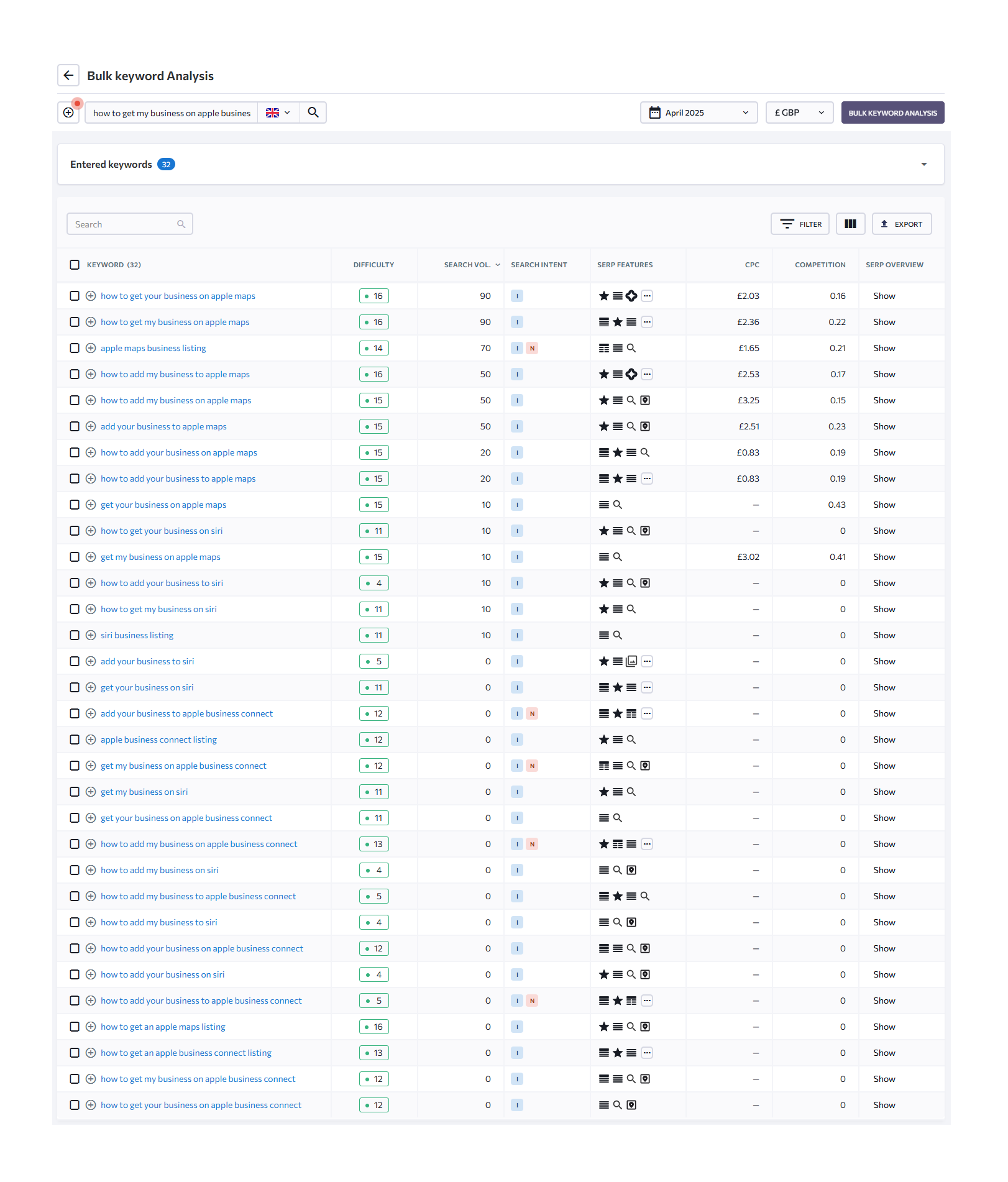
Brandwin Digital use an SEO tool called SE Ranking and access to this tool has allowed us to conduct some initial long-tail keyword research. These results will enable us to optimise campaign content accordingly.
A copy of the results are exhibited below at Appendix 1 (click here to view):
These results appear to show that there is an opportunity for campaign content to perform positively. This research shows that in the short term “Apple Maps” is clearly the choice phrase being used at the moment, however, whilst search volume are currently negligible or none-existent for phrases using an exact-match for the term “Apple Business Connect”, choosing to optimise for that term now may futureproof any SEO efforts if and when this service becomes more widely known.
Considering Google’s “semantic searching” technique means that results will likely be presented based on Google recognising the relationship between “Apple Business Connect” and “Apple Maps” as overlapping terms – which means both getting found using both sets of keywords, and also bringing additional benefits associated with increased authority based on topical relevance.
(SE Ranking, no date), (Google Cloud, no date), (Ahrefs, no date)
Planning
Campaign calendar
Before we create content, we have considered what sort of content is needed by drafting up a simple campaign calendar that maps the content type against a stage in the customer journey using the AIDA model.
A copy of this calendar is available to view at Appendix 2 (click here to view).
We have also considered some other factors in an effort to optimise engagement:
- Emails to be sent between 9am – 11am on weekdays, either Tuesdays, Wednesdays or Thursdays to yield maximum click-through rates for a B2B audience.
- Facebook posts to be timed between 8am – 12p for better engagement.
- Instagram posts to be timed around 10am (or mid-morning) for higher engagement.
- Blog posts to be timed around mid-week and to complement other campaign messaging.
(Coolbear, 2024), (Hanlon, 2023), (Salesforce, no date), (Sprout Social, 2025)
Optimised content
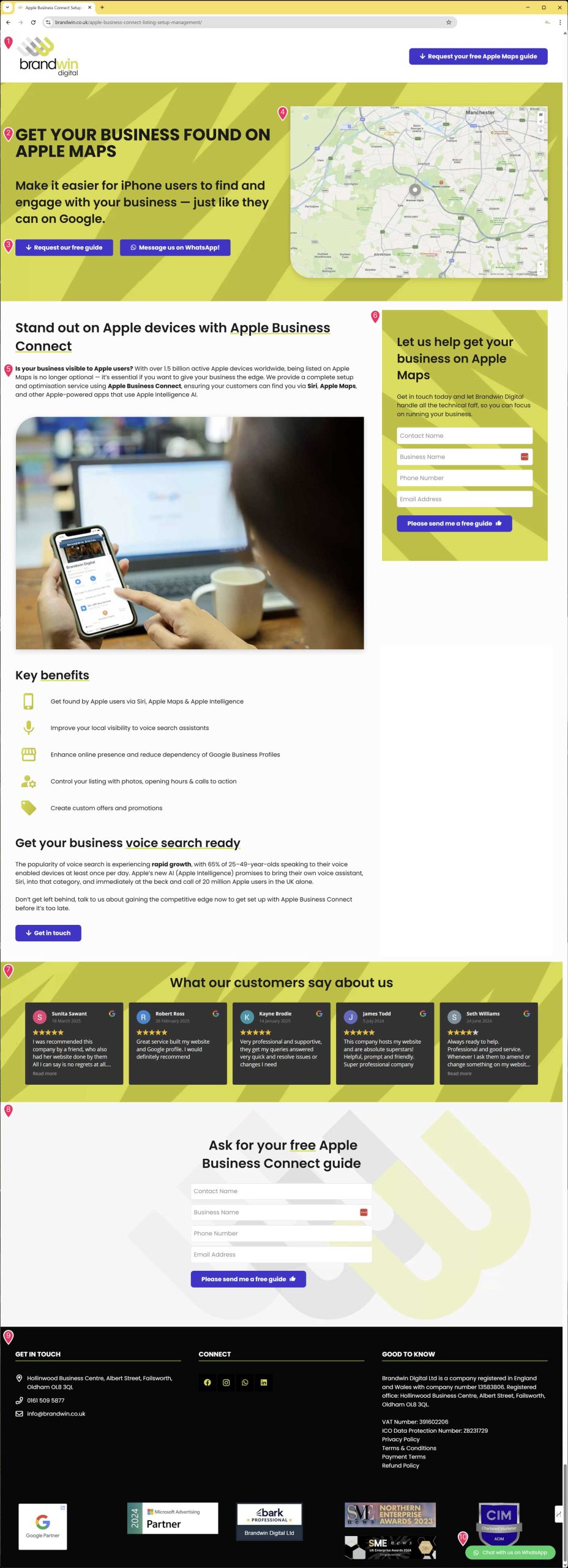
Campaign landing page
This campaign landing page will act as a content and detailed information hub, as well as the campaign’s primary conversion point.
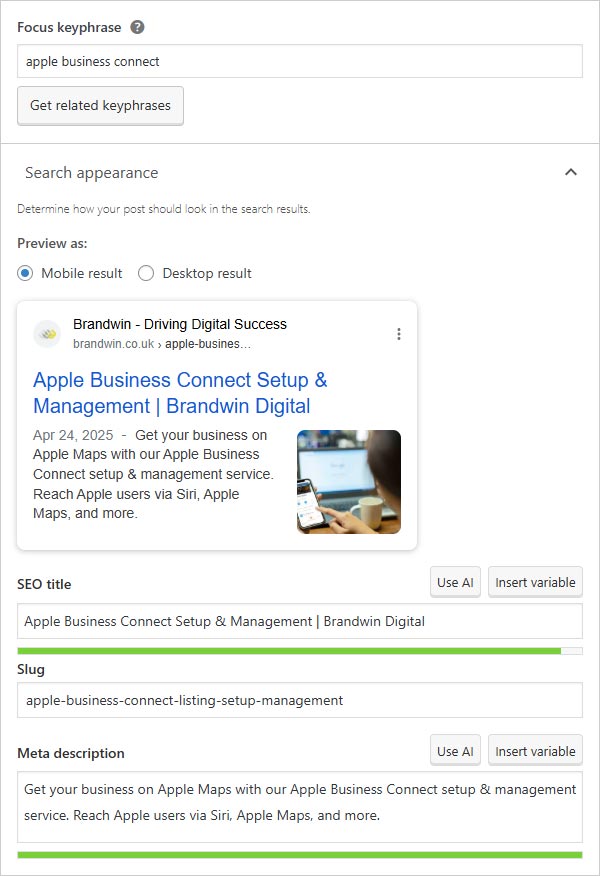
Optimisations


Additional technical SEO has also been implemented with the use of an SEO plugin (Yoast) to ensure that we have optimised the page title, slug, meta description and featured image.
(Unbounce, no date), (Romanchuk, 2024)
Optimised content
Instagram Post & Story
Introductory social media Post and Story to kick the campaign off, linking back to a Blog post.
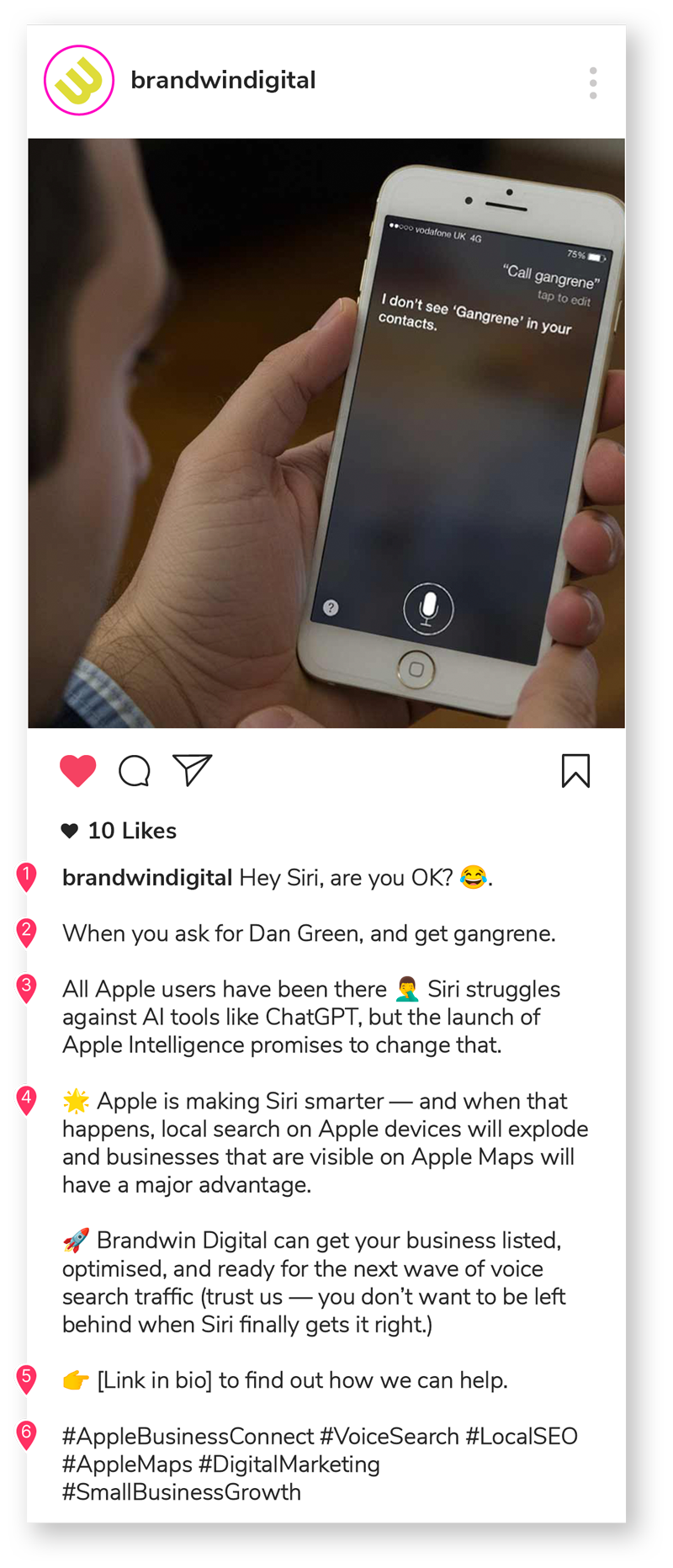
Optimisations
(McLachan, 2023), (Ashcraft, 2023)
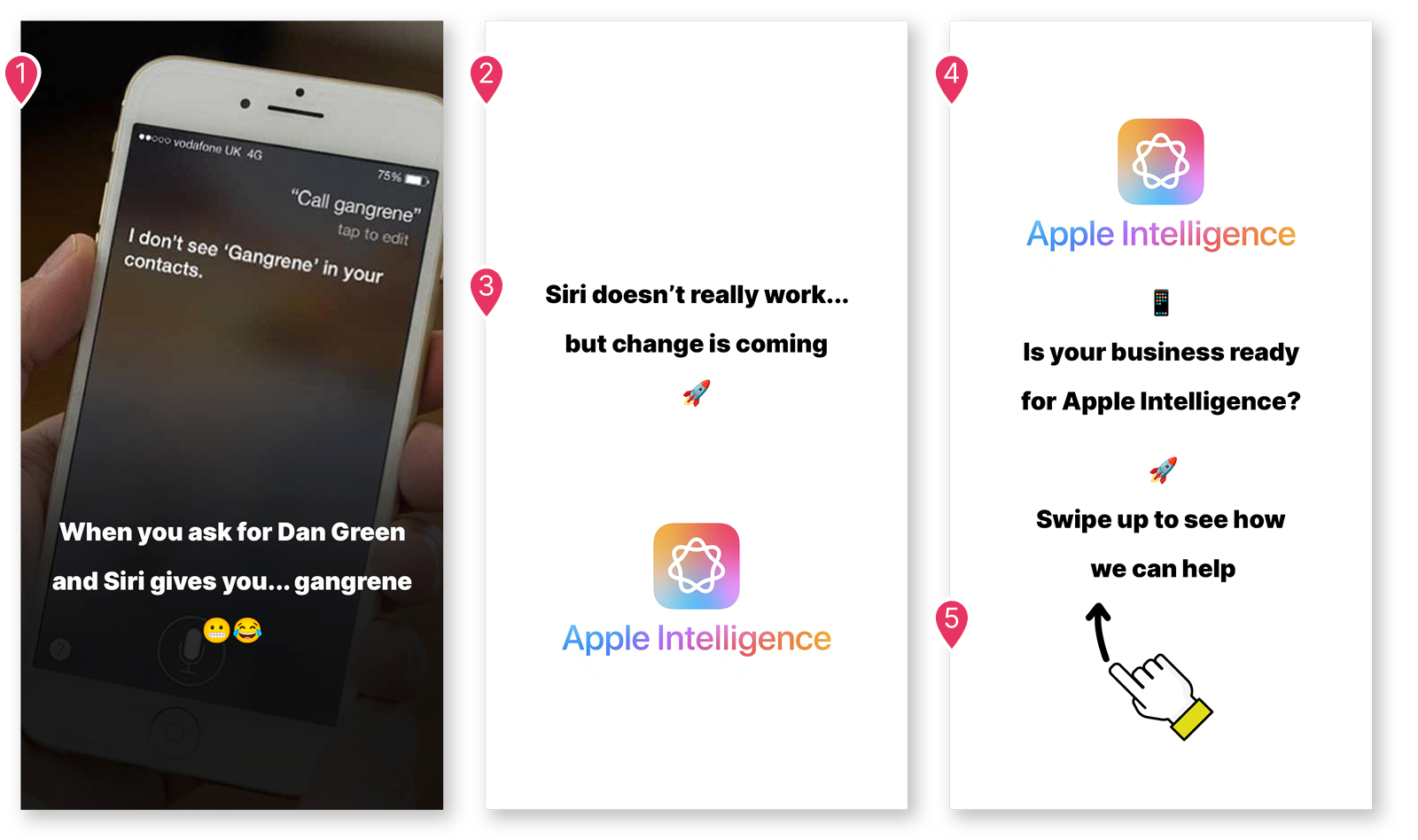
Optimisations
Optimised content
Campaign Email
Introductory email sent to subscribed audience of existing customers at the campaign beginning.
Optimisations
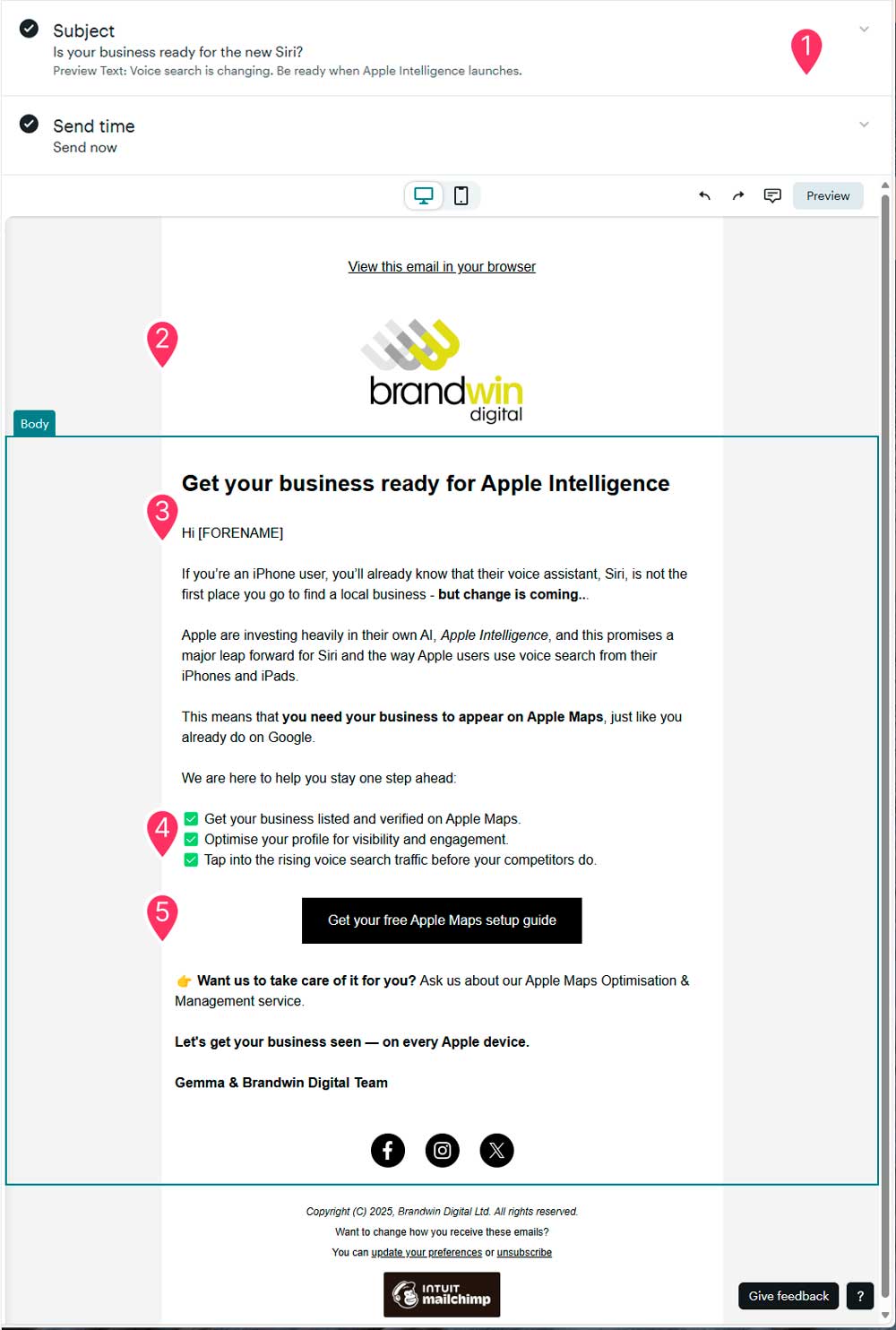
(Mailchimp, no date b), (Mailchimp, no date c)
Optimised content
WhatsApp Business Chat
Message sent from WhatsApp Business channel to existing customers.
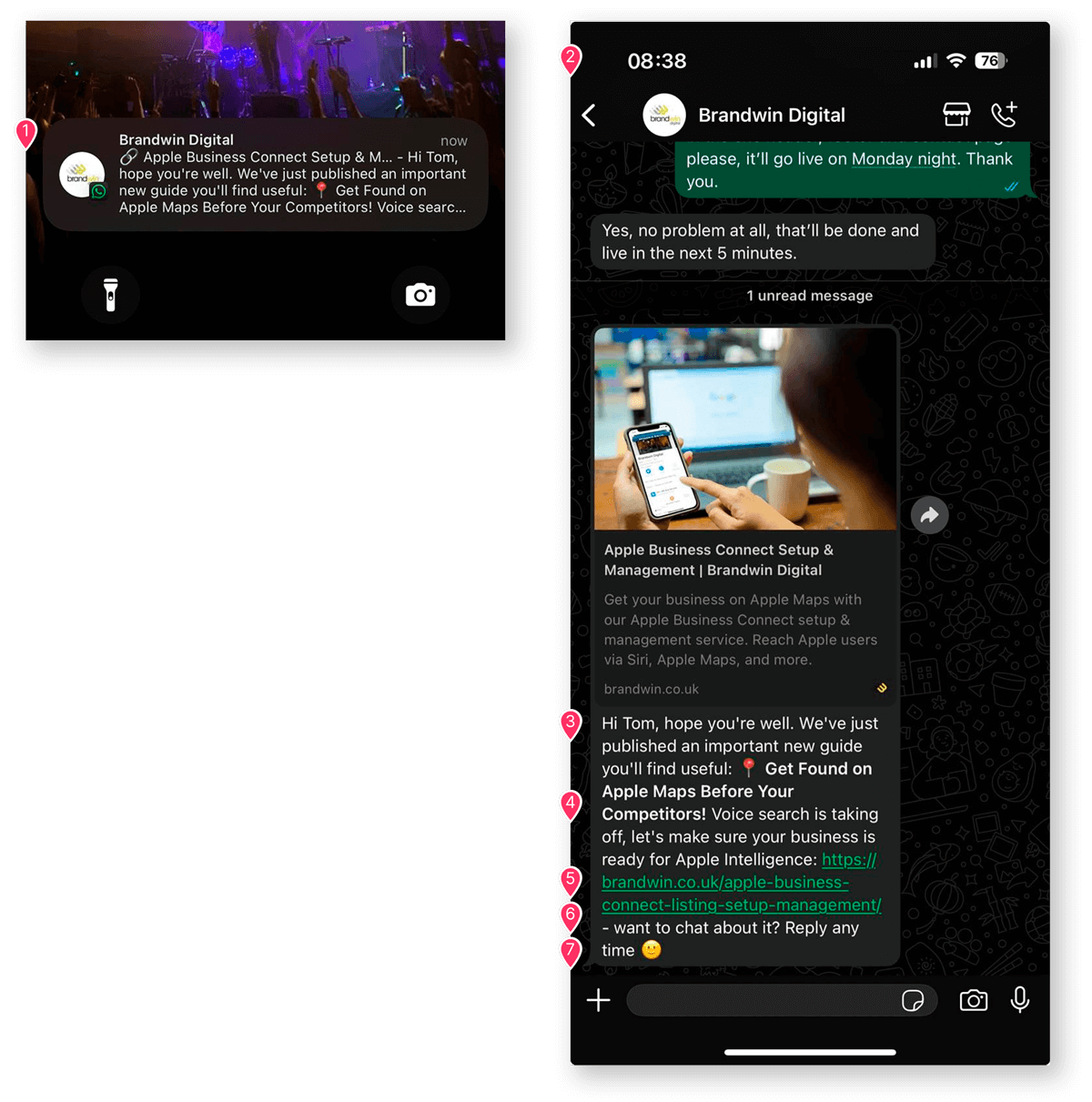
Optimisations
Additional optimisation
Additionally, we have made sure that Brandwin Digital’s WhatsApp profile is correctly populated with company contact details and a descriptive catalogue of services. Whilst this element of optimisation isn’t necessarily of great importance to existing customers, it should benefit new customers choosing to contact Brandwin Digital for the first time through WhatsApp.
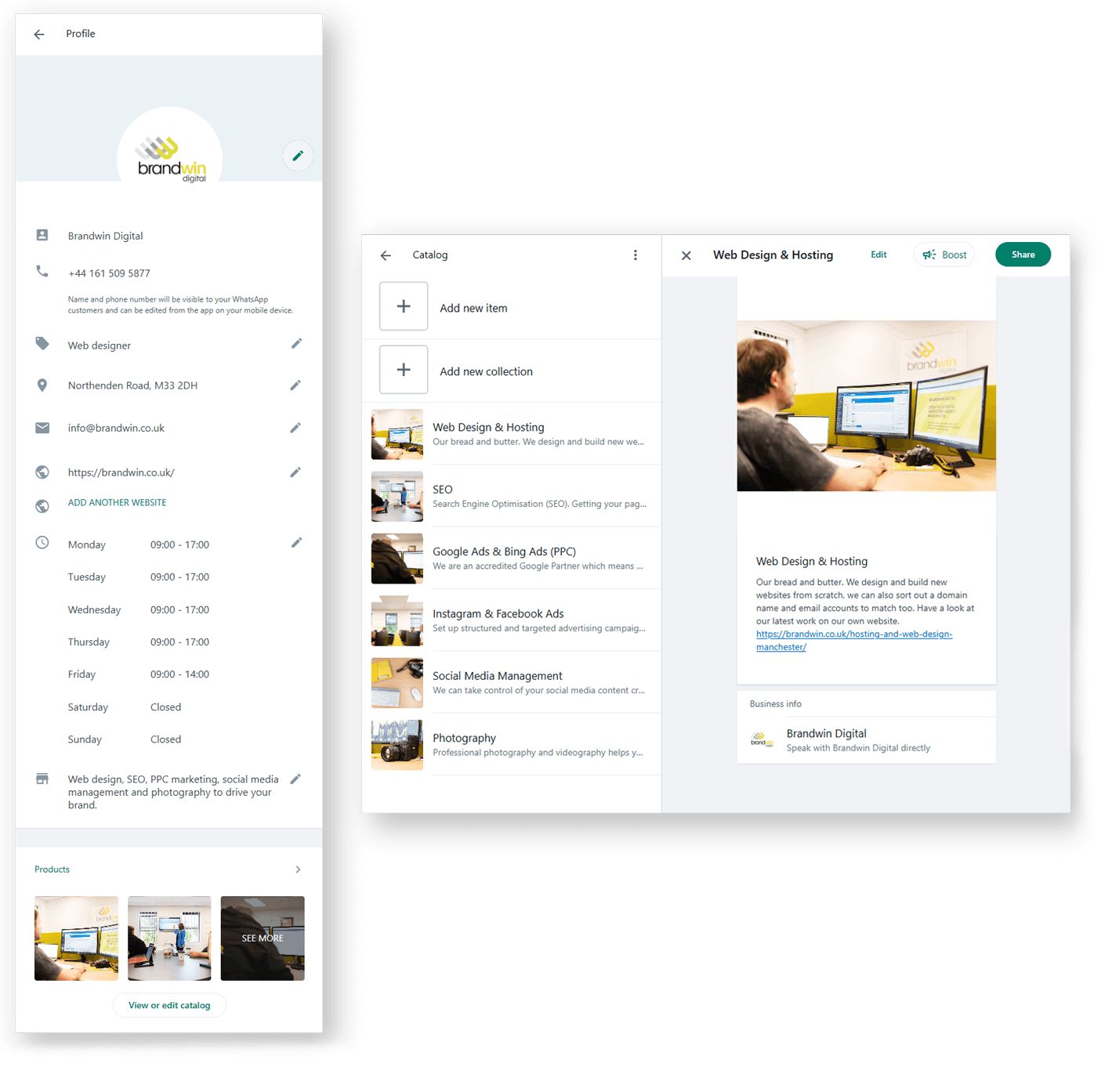
(ADA Global, no date), (Coleman, 2022)
Optimised content
Facebook Post
A short testimonial style post to optimise for Facebook’s unique platform strengths, e.g. social validation and engagement. In contrast to how our Instagram posts contain humour, our Facebook posts are optimised for gaining credibility.
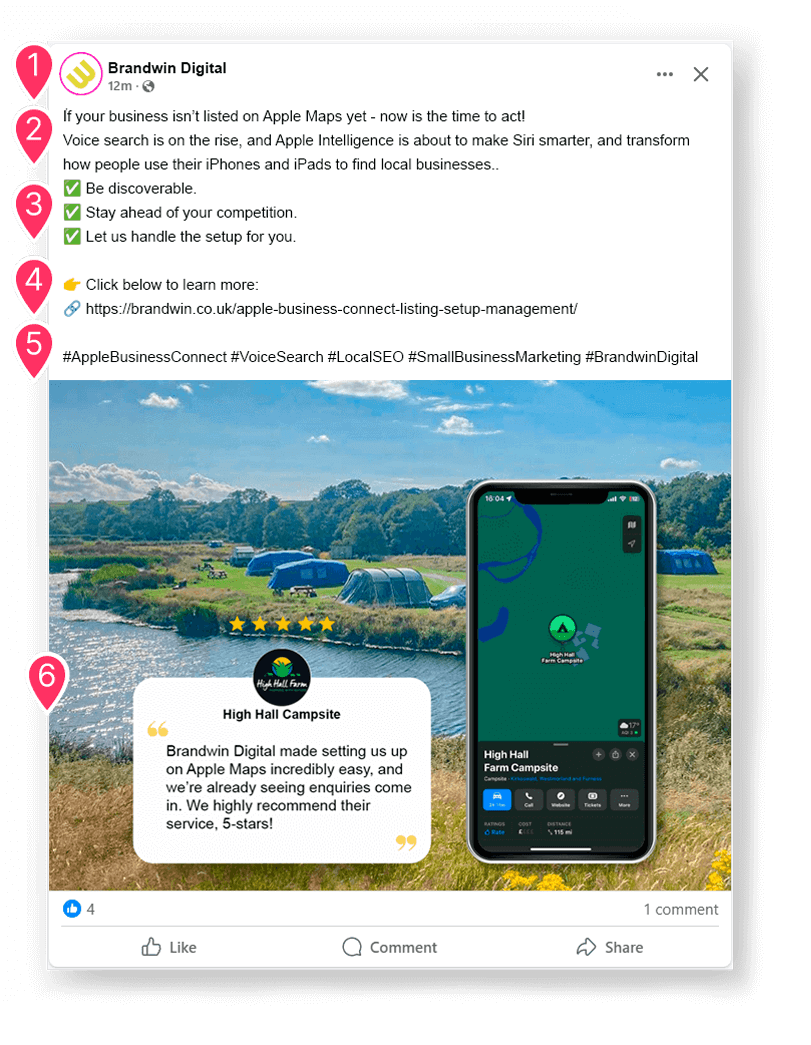
Optimisations
(Sprout Social, 2025)
In conclusion
Recommendations
These following recommendations have not been made with the benefit of real-world campaign data as. These are therefore observations made by comparing best practice with current processes at Brandwin Digital.
Continue with the use of dedicated landing pages for marketing campaigns that do not provide integration with the wider site navigation elements, such as site menus and links to other internal pages. Where possible, use ‘sticky’ calls to action – such as floating contact forms on desktop views, and floating contact buttons on smaller screen devices, ensuring page layouts are optimised for mobile traffic. Certain elements, such as sticky CTAs, can also be used strategically through the main Brandwin Digital website.
Reasoning: Keeping visitors isolated on a landing page with limited onward navigation options reduces exit rates, and prominent, easily (or always) available calls-to-action provide clear, next step options to promote lead capture.
Use relatable content, real world experiences and humorous content to grab users during the attention phase of the buying journey (AIDA).
Reasoning: Instagram is a fast-scrolling platform, so content that catches the eye, humanising the brand improves both engagement and brand recall.
Email marketing can be used to issue follow us messaging beyond initial contact. Contact lists and audiences can be further segmented to create smaller groups of recipients and therefore introduce the opportunity to issue even more personal messaging. Mailchimp also allows for behavioural triggers, such as follow up emails to individuals that haven’t opened the last email, for example.
Reasoning: Email marketing offers a relatively low cost, low effort opportunity to improve on engagement with increased personalisation in messaging, designed to drive increased conversion rates.
WhatsApp currently presents a significant missed opportunity. It is currently solely used for receiving messages from clients, and responding to them, and is rarely, if ever, used to proactively message clients to promote anything. WhatsApp should be used proactively in this manner, not just for initial outreach, but for timed campaign follow ups too.
Reasoning: WhatsApp’s open rate is significantly higher than that of emails and presents the best opportunity for Brandwin Digital to get messages to existing customers, especially those who did not open emails or engage on other social platforms.
Facebook content is currently identical to content pushed to Instagram, and Brandwin Digital should consider differentiating messaging sent through these platforms. Facebook should be used for slightly more serious messaging and is a great platform to push social proof themed posts for trust building.
Reasoning: Social proof and trust are significant factors that impact conversion rates, especially for small businesses.
Final thought
Brandwin Digital are accustomed operating in an ‘Agile’ manner, and should therefore conduct any future live campaigns with this business practice in mind, with ongoing A/B testing and campaign refinement that adapts to real world results as they become available – especially if a campaign involves cross-channel messaging that requires consistency.
(McKinsey & Company, 2023)
Reflection
This assignment was both one of the most enjoyable and the most frustrating to complete at the same time. Due to workloads and extended periods of overlapping annual leave at work, I decided to apply for a deadline extension through mitigating circumstances. This initially felt like a precaution, but it turned out to be necessary, so I am extremely glad I decided to do that. It was disappointing to be put in that position to begin with, but with the benefit of hindsight, these events gave me the opportunity to work for longer periods of uninterrupted time, and on consecutive days as well – which wouldn’t ordinarily be possible, and I feel like this has helped me significantly.
There were other challenges too – quite early on I had decided on my campaign being based on an Apple Maps optimisation service, tied to the much-hyped release of Apple Intelligence across iOS devices. I was excited to explore this opportunity and I had a fully invested team behind the idea, with my manager keen to offer the service which she saw as a natural up-sell opportunity for our existing SEO customers, as well as a standalone service we could offer to potential new customers. In preparation, we successfully registered and passed Apple’s verification procedure to allow us to function as a third-party agency on behalf of other businesses on their platform, and engaged in a trial with a select number of existing clients. This trial was designed to see if specific actions performed routinely month to month on a Google Business Profile, such as updating images, posting update and responding to reviews produced any measurable performance boost that we could use as a proof of concept to bolster this campaign’s messaging. Unfortunately, management lost patience in March and decided to terminate the trial, and although I felt like this was a premature decision, at around the same time Apple had released Apple Intelligence to their UK customers and it was evident that it was sadly underwhelming. Importantly for me, an enhanced, conversational version of Siri, Apple’s voice assistant – that was a key component of the reasoning behind this campaign idea – had not materialised in the release. Shortly after, also around the beginning of March, reports started to circulate that Apple had “indefinitely delayed” an advanced Siri, potentially until 2027 at best (Macworld, 2025), and as a result we cancelled the campaign.
This was a disappointment, not just because of the initial excitement, but it also meant that I would not benefit from the experience of running the campaign, or from the outcomes it would produce, especially those that might drive optimisation decisions I could use in my work. It also presented a challenge when it came to considering recommendations, which in an ideal world would have been largely based on these experiences. I therefore shifted to creating content theoretically using mock-ups, and based my recommendations on new learning, especially when there were differences between that and what existing practices Brandwin use.
Lastly from a challenge perspective, when I started to build out my portfolio, I chose to do so using PowerPoint, but struggled to present my work within its restrictive, clunky interface, so I opted instead to present this portfolio as a webpage, which gave me the freedom to present it in a manner that closer aligned to how I visualised doing so at the outset and although I don’t regret the decision, it brought a few unforeseen consequences. I found myself spending much longer worrying about what the portfolio looked like from a visual perspective, tweaking things like colours, theme elements and fonts, things I wouldn’t have worried about so much otherwise. I had also not considered the added complexity of optimisation for varying screen sizes, which would be a normal practice for client facing work but was initially an uncertainty I needed to address. Writing directly onto a webpage also denied me access to the usual spelling and punctuation tools, so I’ve had to work around that by using less efficient methods to check my work.
Despite the challenges, one thing that I think will work well is the use of a draft campaign calendar that maps each stage of the campaign to a stage in the buying journey through the AIDA framework. I feel like this gives the campaign structure at a point before any content is created, which allows for us to visualise how messaging needs to evolve as the campaign progresses, especially across multiple channels. This element has also triggered some onward thinking about how this approach could effect future campaigns, and how we could use it to adapt campaign progress by segmenting audiences along the way, depending on how they engage (or don’t). For example, if an individual engages with content in stage one, they progress to the next stage of content, however, for people that don’t engage with content at stage one, perhaps they could then progress to a retargeting stage where the messaging is still aligned with stage one goals.
I have also gained a fresh perspective on the way I consider keyword research results, especially how I value keywords that do not have any or minimal search volumes attached to them. Normally we might be dismissive of these keywords, but in this case where the subject is an emerging trend, I needed to think about whether or not these volumes would rise in the near future, and the benefits that could be had competitively by ranking for them in advance of any eventual volume and difficulty growth.
Finally, I have given thought to what I might have done differently, and what I might have done next if the campaign had gone live. Both questions are difficult to answer without the benefit of real results, but I now realise that I probably had enough time to try and come up with an alternate campaign idea once it became evident that this campaign would not run. I ultimately decided that I would struggle to come up with something that genuinely offered a similar level of real-world promise – nevertheless, it would have been interesting to explore that possibility even if purely to gain some real-world experience and feedback. Choosing to continue on a theoretical basis does feel a little like a missed opportunity, as I am yet to run a campaign of any sort in a real-world environment. Ultimately though, the process of development this campaign has given me greater confidence in my ability to create a strategy and a campaign that offers genuine, real-world opportunities for when that time eventually comes.
Appendices
Appendix 1 – keyword research
Appendix 2 – draft campaign calendar
| Week | Channels Used | Content Focus | AIDA Stage |
| 1 | Blog / Email / Instagram / Facebook | Campaign Launch: Publish cornerstone blog on Apple Intelligence & Siri. Promote ABC via email and social posts. | Attention |
| 2 | Instagram / Facebook / Blog | Educational Content: Posts explaining what ABC is, how it compares to Google Business Profile, and why now. | Interest |
| 3 | Email / WhatsApp / Instagram | Deeper Engagement: Showcase ABC features. Use WhatsApp/email to guide clients to the landing page or opt-in. | Desire |
| 4 | Instagram / Facebook / WhatsApp | Interactive Q&A: Address questions about ABC. Share common queries, handle objections, and highlight use cases. | Desire |
| 5 | Email / Instagram / Facebook | Conversion Drive: Share social proof/testimonials and a limited-time offer. Final CTA push via email and social. | Action |
| 6 | Blog / Email / Instagram | Retention & Reflection: Post campaign recap, thank clients, and gather feedback. Blog about future opportunities. | Action (and Loyalty) |
References
ADA Global (no date) WhatsApp Marketing: Find the Best Time to Send Messages for Optimal Results. Available at: https://www.adaglobal.com/resources/insights/best-time-for-whatsapp-marketing (Accessed: 28 April 2025).
Ahrefs (no date) Topical Relevance. Available at: https://ahrefs.com/seo/glossary/topical-relevance (Accessed: 24 April 2025).
Apple (no date) Apple Business Connect. Available at: https://www.apple.com/uk/business/connect/ (Accessed: 22 April 2025).
Ashcraft, L. (2023) How Later’s Team Writes Engaging Social Media Captions – Later.com. Available at: https://later.com/blog/social-media-captions/ (Accessed: 25 April 2025).
Beattie, A. (2023) Understanding First Mover Advantage – Investopedia. Available at: https://www.investopedia.com/articles/investing/111016/understanding-first-mover-advantage.asp (Accessed: 22 April 2025).
Brandwin Digital (no date) Brandwin Digital Agency, Manchester. Available at: https://brandwin.co.uk/ (Accessed: 22 April 2025).
Brodie, I. (2025) Email Marketing ROI: 2025 Stats That Provie Its Business Value. Available at: https://www.ianbrodie.com/email-marketing-roi/ (Accessed: 23 April 2025).
Chaffey, D. (2025) How to define SMART marketing objectives – Smart Insights. Available at: https://www.smartinsights.com/goal-setting-evaluation/goals-kpis/define-smart-marketing-objectives/ (Accessed: 23 April 2025).
CIPD (2025) SWOT analysis. Available at: https://www.cipd.org/uk/knowledge/factsheets/swot-analysis-factsheet/ (Accessed: 24 April 2025).
Coleman, J. (2022) 16 unexpected ways to use WhatsApp for business – Sprout Social. Available at: https://sproutsocial.com/insights/how-to-use-whatsapp-for-business/ (Accessed: 28 April 2025).
Companies House (no date) Brandwin Digital Ltd. Available at: https://find-and-update.company-information.service.gov.uk/company/13583806 (Accessed: 22 April 2025).
Coolbear, K. (2024) The Power of Social Media Content Calendaring – Colorado State University. Available at: https://social.colostate.edu/best-practices/the-power-of-social-media-content-calendaring/ (Accessed: 24 April 2025).
Dixon, S. J. (2025) Most popular social networks worldwide as of February 2025, by number of active users. Available at: https://www.statista.com/statistics/272014/global-social-networks-ranked-by-number-of-users/ (Accessed: 23 April 2025).
Google Cloud (no date) What is semantic search? Available at: https://cloud.google.com/discover/what-is-semantic-search (Accessed: 24 April 2025).
Hanlon, A. (2021) Customer journey models t master your omnichannel strategy – Smart Insights. Available at: https://www.smartinsights.com/marketing-planning/marketing-models/mckinseys-consumer-decision-journey/ (Accessed: 22 April 2025).
Hanlon, A. (2023) The AIDA model. Available at: https://www.smartinsights.com/traffic-building-strategy/offer-and-message-development/aida-model/ (Accessed: 24 April 2025).
Harvard Business School (no date) The Five Forces – Institute For Strategy & Competitiveness. Available at: https://www.isc.hbs.edu/strategy/business-strategy/Pages/the-five-forces.aspx (Accessed: 24 April 2025).
LinkedIn (2023) Building Trust With Your Customers Through Automated Messaging. Available at: https://www.linkedin.com/pulse/building-trust-your-customers-through-automated-messaging/ (Accessed: 23 April 2025).
Macworld (2025) Apple’s next-gen Siri might be delayed until 2027. Available at: https://www.macworld.com/article/2624966/apples-next-gen-siri-might-be-delayed-until-2027.html (Accessed: 29 April 2025).
Mailchimp (no date a) Email Marketing Benchmarks and Metrics Businesses Should Track. Available at: https://mailchimp.com/resources/email-marketing-benchmarks/ (Accessed: 23 April 2025).
Mailchimp (no date b) Best Practices for Mailchimp Emails. Available at: https://mailchimp.com/help/best-practices-mailchimp-email/ (Accessed: 27 April 2025).
Mailchimp (no date c) How to Avoid Email Spam Filters. Available at: https://mailchimp.com/resources/avoid-spam-filters/ (Accessed: 27 April 2025).
McKinsey & Company (2023) What is agile? Available at: https://www.mckinsey.com/featured-insights/mckinsey-explainers/what-is-agile#/ (Accessed: 28 April 2025).
McLachlan, S. (2023) The Complete Instagram Marketing Strategy Guide- Hootsuite. Available at: https://blog.hootsuite.com/instagram-marketing/ (Accessed: 25 April 2025).
Mmeje, C. (2025) Domain Authority: what is it and how is it calculated – Moz. Available at: https://moz.com/learn/seo/domain-authority (Accessed: 23 April 2025).
Mortensen, O. (2025) What Is The Chance to Rank for Difficulty Keywords – SEO.AI. Available at: https://seo.ai/blog/what-is-the-chance-to-rank-for-difficulty-keywords (Accessed: 23 April 2025).
Rasdien, T. (2025) Why your brand’s legitimacy matters more than ever is 2025 – LinkedIn. Available at: https://www.linkedin.com/pulse/why-your-brands-legitimacy-matters-more-than-ever-pkl7c/ (Accessed: 23 April 2025).
Romanchuck, J. (2024) 41 Landing Page Design Examples to Inspire Your Own – HubSpot. Available at: https://blog.hubspot.com/marketing/landing-page-examples-list (Accessed: 25 April 2025).
Salesforce (no date) The best time to send marketing emails. Available at: https://www.salesforce.com/marketing/email/best-time-to-send-emails/ (Accessed: 24 April 2025).
SE Ranking (no date) Powerful agency-tailored SEO software designed for pros. Available at: https://seranking.com/ (Accessed: 24 April 2025).
Sprout Social (2025) Best times to post on social media in 2025. Available at: https://sproutsocial.com/insights/best-times-to-post-on-social-media/ (Accessed: 24 April 2025).
Unbounce (no date) Landing page best practices. Available at: https://unbounce.com/landing-page-articles/landing-page-best-practices/ (Accessed: 23 April 2025).
WhatsApp Business (2023) 4 Ways Marketing Leaders Should Be Using WhatsApp to Help Achieve Business Goals. Available at: https://business.whatsapp.com/blog/use-whatsapp-business-goals (Accessed: 23 April 2025).
Wylie, L. (2025) Navigation App Revenue and Usage Statistics (2025) – Business of Apps. Available at: https://www.businessofapps.com/data/navigation-app-market/ (Accessed: 22 April 2025).